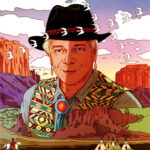










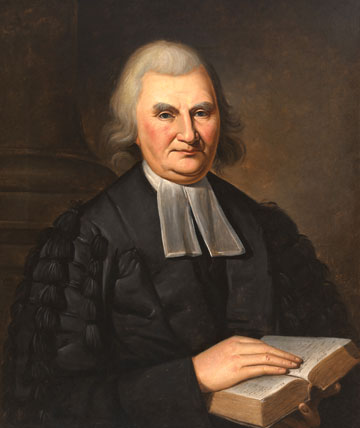
Just one clergy member and college president signed the Declaration of Independence: John Witherspoon of New Jersey.
Witherspoon was a Presbyterian minister who left his native Scotland in 1768 to become the sixth president of the College of New Jersey, which later took the name Princeton University. (Princeton Theological Seminary, less than a mile down the road, was not established until 1812.) According to a short biography on the university website, Witherspoon – in addition to managing the college’s affairs and providing instruction in moral philosophy, divinity, rhetoric, history, and French – preached twice on Sundays.
Before his arrival in the American colonies, Witherspoon had been a leader in the Church of Scotland’s “Popular Party,” an evangelical movement emphasizing piety, orthodox Calvinism, and the belief that regular congregants should have a say in selecting their minister.
So perhaps it’s no surprise that Witherspoon had words of wisdom for the colonists as they moved toward independence. A few months before signing the Declaration of Independence, Witherspoon delivered a sermon titled “The Dominion of Providence over the Passions of Men” that caused a stir among colonists.
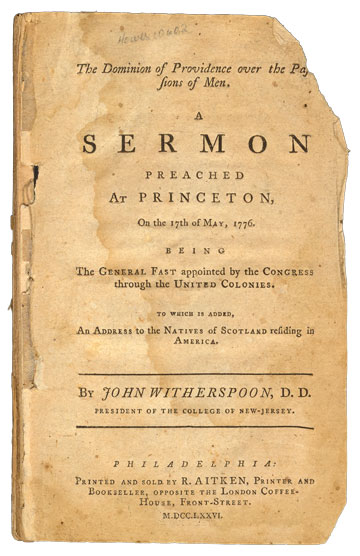
On May 17, 1776, a date set aside by the Continental Congress for fasting and prayer throughout the colonies, Witherspoon began by telling his congregation, “You are all my witnesses, that this is the first time of my introducing any political subject into the pulpit.” And: “At this season however, it is not only lawful but necessary, and I willingly embrace the opportunity of declaring my opinion without any hesitation, that the cause in which America is now in arms, is the cause of justice, of liberty, and of human nature.”
In just over 11,000 words, Witherspoon cites more than a dozen scripture passages in support of his message, including ones from Genesis, Samuel 1 and 2, Psalms, Luke, and Acts. He concludes by urging his listeners and readers to promote public virtues, bear down on profanity and immorality, and exercise courage, diligence, and frugality as they struggle through the hardships of war.
“Remember that your duty to God, to your country, to your families, and to yourselves, is the same,” Witherspoon wrote. “True religion is nothing else but an inward temper and outward conduct suited to your state and circumstances in providence at any time.”
A copy of the sermon is on display through July 12 at Princeton’s Firestone Library as part of the exhibit Nursery of Rebellion: Princeton & the American Revolution. The fully digitized exhibit remains online at dpul.princeton.edu.