











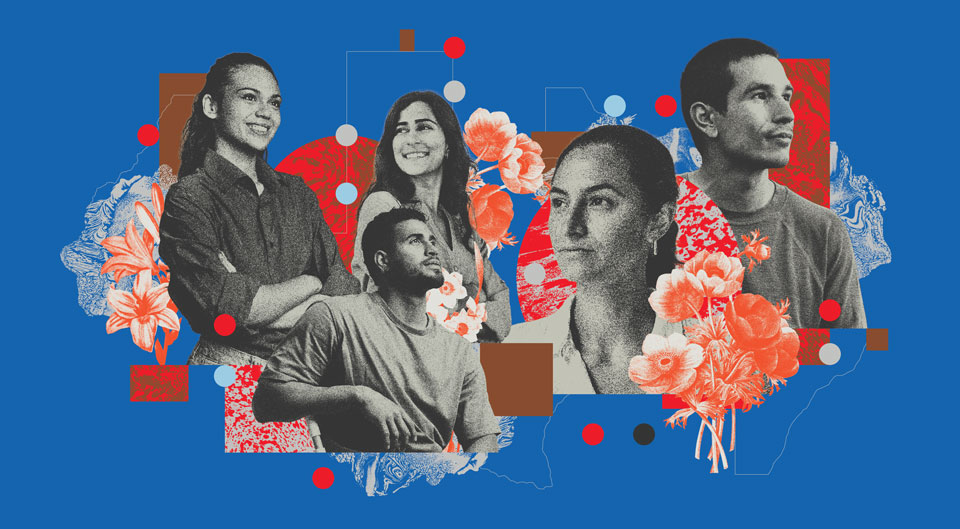
Lexi Torres is completing her first year as a graduate student pursuing a Master of Divinity degree from Saint John’s School of Theology and Seminary in Minnesota. Her journey to the school was not without difficulty, though there is both precocity and calling in her telling.
“I’m biracial; half Hispanic and half Swedish,” she says. Growing up in the Minneapolis suburbs exposed her to “some hard things.” She neither explains nor dwells on those memories, however, in high school she joined intercultural clubs and organizations and “tried to the mend the gap at my school.”
Upon graduation, she was accepted to the College of Saint Benedict and Saint John’s University, which comprises a men’s and women’s college at the undergraduate level, as well as Saint John’s School of Theology and Seminary. The institution is grounded in Benedictine traditions of monastic life and place-based commitment and the Order’s values of prayer, community and hospitality.
Saint John’s was founded in 1857 by the monks of Saint John’s Abbey who had accompanied the waves of German and Scandinavian immigrants that settled the upper Midwest; Saint Benedict’s opened nearly 50 years later as a women’s college. Since 1961 the two institutions have operated as a fully integrated academic partnership, though they remain legally distinct with separate boards, endowments, and single-sex residential identity. Undergraduate students reside on separate campuses three miles apart, and share classes, faculty, and a single academic catalog.
Torres majored in communications with a minor in global health, which provided avenues to pursue research in health disparities among marginalized communities, specifically the growing rural Hispanic communities and issues of maternal morbidity and mortality, she says. She also discerned an incipient calling to ministry, and participated in “Youth in Theology and Ministry,” a summer program founded in 2000 by the School of Theology and Seminary (with funding from Lilly Endowment Inc.) to engage high school students in theology. Selected as a counselor for the program as a junior, she saw the passion the participants had for engagement with the Church and their barriers. During spring break that following year, a mission trip to serve the unhoused in Denver, reinforced her resolve to pursue nonprofit work.
Torres graduated in 2025 and enrolled in the Saint John’s School of Theology and Seminary Master of Divinity program to prepare for lay ministry. In her first year she was selected to participate in an immersion experience in Texas at the U.S./Mexico border through the school’s ongoing partnership with the Mexican American Catholic College (MACC) in San Antonio, Texas.
“This was one of the most transformative encounters in my life,” she says, recalling heartrending first-hand experiences with desperate immigrants – adults and children alike – walking hundreds of miles, traversing the Rio Grande, to seek new lives in the United States. “And we had a priest with us who said, ‘If Jesus were to come back today, He would come through the valley.’
“I 100% believe this.”
Complementary partners
Saint John’s association with MACC began in 2021 with the support of a $50,000 Lilly Endowment planning grant for an initiative exploring the challenges and opportunities in rural churches and intercultural ministry. Although separated by some 1,300 miles and different traditions in the Catholic Church, the two institutions share a rich spiritual and vocational connection.
“Saint John’s exists in a deeply Benedictine context,” says Shawn Colberg, Ph.D., who joined the school as a member of the theology faculty in 2017 and was appointed dean in 2022. “We are sponsored by a large monastic community – at one time the largest in the world – and our deepest commitments to rural ministry follow the legacy of the abbey or the monastic communities that settled here. The communities of both Saint Benedict’s and Saint John’s chose to settle in the countryside with the pioneers from Germany and Central Europe who emigrated here.
“And that’s not unusual for monasteries, which often are in rural spaces. Benedictine communities also take a vow of stability to a place, and that extends to Saint John’s and its relationship with our rural community.”
In the past two decades, that stability has been threatened by declining numbers of people living in rural America, Colberg says, and fewer Catholic clergy to serve them. “In our diocese we have about 150 parishes, which is quite high, but most are clustered into smaller groups of parishes being pastored – if we’re lucky – by two ordained priests. And over the top of these shifts is the growing presence of our Latino brothers and sisters.”
Hispanic migrant workers have for several decades worked seasonally on farms and in poultry-processing plants in Minnesota and other upper Midwest states, and in recent years there has been a growing permanent population. The Minnesota Department of Employment and Economic Development reports that the Hispanic population in the state more than doubled between 2000 and 2020, totaling some 95,000 residents; most live in the Twin Cities area, but a solid third of the Hispanic population is in Minnesota’s many rural areas. Hispanic people now represent about five percent of Minnesotans.
“One of the things the School of Theology and Seminary has been working on for nearly 10 years is intercultural competency,” Colberg says. “We couch that in intercultural humility: How do we understand ourselves as culturally located and part of a global, multicultural church?”
Our deepest commitments to rural ministry follow the legacy of the abbey or the monastic communities that settled here.
The school reached out to MACC and invited colleagues there to conduct workshops for Saint John’s faculty to better understand this changing landscape.
Established in 1972 as the Mexican American Cultural Center, MACC initially provided pastoral formation and language study for the growing Spanish-speaking communities in the United States; by the 1990s it was responding to growing immigration from Central and South America, and its scope had expanded as a national center for theological education, and a catalyst for development of Hispanic ministry throughout the U.S. with an overarching mission to address systemic racism and foster intercultural understanding.
In 2008 MACC became a diocesan Catholic college in the Diocese of San Antonio, the first post-secondary institution in the country to offer a bilingual Bachelor of Arts degree. Today, it partners with San Antonio’s University of the Incarnate Word (UIW) and is housed on UIW’s campus, providing pastoral ministry courses to complement other coursework.
“As we got to know each other, we talked about our mutual aspirations as institutions,” Colberg says. “We thought we had something to share with each other, pastorally and intellectually. We’ve known we need to grow our intercultural capacity, and by partnering with MACC, they can offer courses through the School of Theology. It just immediately expands capacity for both institutions.”

A laboratory for formation
The $50,000 Lilly planning grant in 2021 helped the seminary identify challenges and opportunities, notably a collaboration with MACC.
The San Antonio school also had received Lilly funding for faculty and student exchanges and course sharing between the two institutions, including MACC’s online intercultural competencies course.
The planning grant became the foundation for Saint John’s $1 million Pathways Phase 2 grant. Entitled Conversatio: Creating a Culture of Encounter, its focus is pastoral formation with an emphasis on intercultural competence and engagement. Today it supports a formal partnership with MACC and rural parishes in Minnesota to equip students and faculty for the challenges of rural ministry.
“When we received our Conversatio grant I began directing graduate and undergraduate students in what is essentially a laboratory of ministerial formation, arranging partnerships with parishes, organizations, and diocesan offices,” says Donelle Poling, director of Conversatio. An alumna of both the College of Saint Benedict and Saint John’s School of Theology and Seminary, she returned to the school in 2016 to direct the Youth in Theology and Ministry Program.
“In 2017 I heard about the immersion program offered by MACC, and I thought it would be good professional development for the youth program. The program is being run by Catholic Charities, which works closely with Border Patrol, bringing immigrants seeking asylum to a camp until they can be processed.”
Her experience mirrored that of Torres. She recalls meeting a woman who was eight months pregnant and accompanied by her two young children. They had walked to the border from Honduras and crossed the river. Their clothes were still wet when they arrived. “She kept saying ‘I’m so cold. I’m so cold,’” Poling recalls. “She was upset because she lost her only possession, a necklace, in the river. She told us she had wanted to get caught so that her kids could have a warm place to stay.
“That was eye-opening for me, an experiential osmosis; you feel this shift that is deeper than just the intellect. To be invited into that spiritual ground was an honor.”
“A precious context”
Daniella Zsupan-Jerome, Ph.D., has been a member of the faculty at Saint John’s since 2023, following two years as the school’s director of ministerial formation and field education. She is reflective, precise, and direct, qualities that serve her well as director of Sustained Encuentro: Accompanying One Another Along the Way, the school’s multi-faceted project funded by a $5 million Pathways Phase 3 grant.
An alumnus of Saint John’s School of Theology’s M.A. in Liturgical Studies, she has an undergraduate degree from University of Notre Dame, an M.A. from Yale Divinity School, and a Ph.D. from Boston College.
As an immigrant from Hungary, her perspective on intercultural ministry, she says, is “more personal, understanding what it means to belong, having a sense of stability, and knowing what it’s like to integrate.” Her concept of the rural framework is similarly thoughtful and nuanced. “I like to say it’s blessed and gifted: a deeply relational, community-oriented context that finds itself on the margins struggling for resources that we might assume in an urban or suburban setting. People in ministry here will wear multiple hats, pivot easily, and be flexible.”
That interpretation characterizes a distinctly Benedictine approach to the administration of Sustained Encuentro (meeting), with its focus on bringing “stability to a place,” educating lay ecclesial ministers and permanent diaconal candidates to assist ordained priests in ministry, and facilitating formational opportunities for intercultural ministry.
“Intercultural ministry is about mutual hospitality with a context other than your own,” she says. “And so we try to foster a sense of humility and a sense of hospitality.”
To that end, she has overseen the implementation of immersion programs for faculty and students in the past three years, one at Collegeville for a week in the early summer, which has explored the rural agricultural context and culture through site visits, expert speakers, facilitated theological reflection and liturgical prayer with monastic communities, and “Hispanic Ministry at the 21st Century,” an 11-day site visit in coordination with MACC at the U.S./Mexico border near San Juan, Texas, some 240 miles south of San Antonio.
“From the very beginning, we were complementary partners,” says Father Juan J. Molina Flores, Ph.D., president of MACC since 2021. “We saw what we could create together more than what we could simply add to one another; we draw on strengths, so that both institutions will be much stronger, and our students will have a much broader perspective about their own ministry.”
Zsupan-Jerome says: “We see value in our formational vision in dialogue and bridge-building together across differences, giving students experiences that help them form skills and ability to do that work.”
From the very beginning, we were complementary partners. We saw what we could create together much more than what we could Simply add to one another.
Conversion
Colberg is a scholar of medieval Church history, and the ingrained discipline of the historian persists as he scans the current landscape of the Catholic Church in the United States. He views the array of programs in the Pathways for Tomorrow project as the latest thread of an enduring fabric of the Catholic Church in the United States for nearly four centuries. At the moment, the school is planning for a future that builds on its recent history: Saint John’s has received a $10 million Large-Scale Collaboration Grant from the Lilly Endowment to pioneer Stabilitas: Renewing Rural Ministry, which is aimed at preparing and forming ministerial leaders in rural and mission dioceses in the United States.
“The Church in the United States is right now faced with a tremendous opportunity,” Colberg says. “How will we embrace this Latino group in all its diversity, and let it be the agent that Irish Catholics and German Catholics, Italian Catholics and Eastern Catholics have been? Will our parochial schools and colleges be bridges that facilitate social mobility and growth into the fullness of life – both ecclesial and social – in the United States in the years to come?
“The deepest hope is that Saint John’s breathes out more women and men into rural ministry and rural ministerial leadership. And that we can bring vibrancy to dioceses that really are looking for help.
“If we can look back in a decade and say there are more women and men doing good ministry across these rural dioceses, that would be just a wonderful aspirational and missional accomplishment.” .
Mark L. Kelly is Consulting Editor for In Trust magazine.