










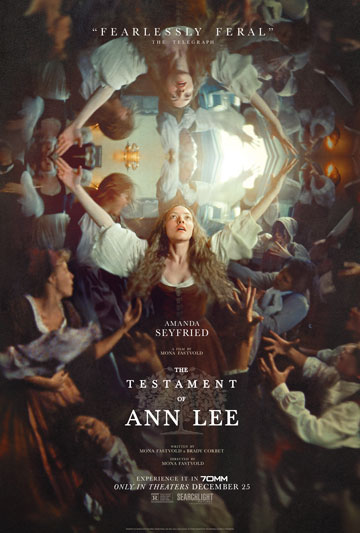
The Testament of Ann Lee
Directed by Mona Fastvold
137 minutes
With an unflinching gaze and a haunting soundtrack, this creative telling of the life of Ann Lee, leader of the Shakers, starts with the spiritually minded Ann as a child in Manchester, England. At the time – the 1750s – “George Whitefield persistently preached his sermons from the steps of Christ Church,” the narrator says, “and Ann yearned to dedicate herself to serving God with equal fervor.” She eventually connects with the Wardley Society, where she first encounters women preachers. She marries and bears four children, all who die before their first birthdays. After experiencing illness and mystical visions, Ann becomes convinced that the root of suffering is sexual sin. She shares her revelations with her coreligionists, and they embrace her as the second coming of Christ. Unsurprisingly, they face persecution at home. After arriving in America in 1774, the community faces opportunity and brutality. They settle outside Albany and live out their tenets of celibacy, egalitarianism, pacifism — and the namesake shaking, portrayed as ecstatic physical prayer accompanied by wailing and song. Material culture fans will notice Shaker-tradition furnishings in the final scenes.
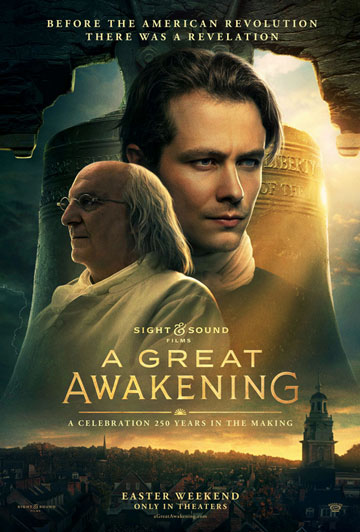
A Great Awakening
Directed by Joshua Enck
128 mins
Highlighting the unlikely friendship between Benjamin Franklin and 18th-century English evangelical George Whitefield, this film captures Whitefield’s role in the Great Awakening and the impact his preaching had on the American colonies and nation.
Set in 1787 Philadelphia, 17 years after Whitefield’s death, the story begins with an octogenarian Franklin at the Constitutional Convention, troubled at the division among its delegates and pondering a way forward. Flashbacks show young Franklin in New England and young Whitefield in England. Whitefield dreams of becoming a great actor and enrolls at Oxford University, where he meets the Wesleys and undergoes a spiritual awakening, vowing to use his oratorical prowess for Christ. Scenes of Whitefield preaching outside a coal mine and inside a country church convey his dynamism. When he arrives in Philadelphia, thousands gather to hear him. Franklin, publisher of the Pennsylvania Gazette, covers the event; once the two men meet, Franklin agrees to publish Whitefield’s sermons. A friendship begins.
Naturally, their religious differences and disagreements on slavery lead to vigorous debate. But in this telling, Franklin is so moved by Whitefield’s Christian devotion that he inspires a solution that helps advance the foundering early republic.