









Yes, of course artificial intelligence is here, and its future may be beyond the bounds of what any science fiction writer could imagine. The real question isn’t whether it affects humanity but how it affects humanity – and how people can be faithful to what it means to be human in the AI age.
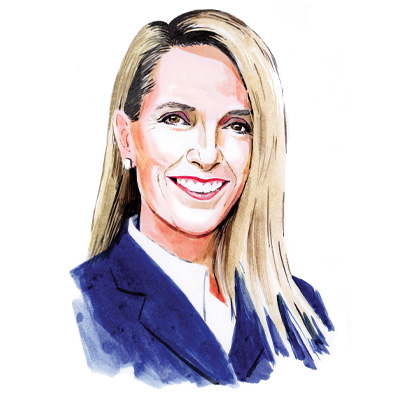
Last year, as headlines were declaring that the artificial intelligence age had dawned, a team at the University of Notre Dame unveiled the DELTA Framework for understanding humanity in the wake of this technology. (DELTA is an acronym for Dignity, Embodiment, Love, Transcendence, and Agency.) Meghan Sullivan, Ph.D., the founding director of the Institute for Ethics and the Common Good and director of the university’s Ethics Initiative, has led the work to develop the framework, funded by Lilly Endowment Inc., and joined the Good Governance podcast to discuss how to view humanity through the new framework. What follows is from that discussion.
1) Dignity – made in the image of God
Dignity lies at the heart of the Christian response to artificial intelligence and the way people should see others, Sullivan said. She told a story of a conversation with Cardinal Christophe Pierre last year before his retirement as the Vatican’s ambassador to the United States. Walking him through the framework, Sullivan said she was stopped and the cardinal exclaimed: “Dignity, dignity, dignity. All you need is dignity. You don’t even need the other four letters!”
With the capabilities of artificial intelligence, the value of human work is changing. AI is already disrupting the job market and the economy, but in the Judeo-Christian faith, human dignity goes to creation.
“As Christians, we believe that humans are made in the image and likeness of God,” Sullivan said. “We have inherent value that has nothing to do with how productive we are, with how fast we can solve math problems, with our ability to generate memes for the Internet quickly. Our dignity never had anything to do with any of those capabilities with which you might be compared to a piece of software.”
That is a difficult concept to consider in society in which work is, of course, based on productivity and know-how, and many jobs – and salaries – are based on tasks and skills that AI can handle. Already, some high-paying jobs that include a measure of social status are being upended by the technology, including those in law, coding, and engineering. What does it look like to see a job replaced by AI?
That’s one area where theological schools can help ministers and people think through how they approach their lives, particularly when it comes to their occupations and what things have meaning – and what value we place on them.
“I think it’s very, very important that Christians, as they enter these debates about AI, be very vocal, very confident champions in human dignity and, in particular, the idea that human dignity is something you are just given,” Sullivan said.
She noted that had she asked students in a philosophy class why humanity was special, many of the things they would have said – the ability to create, think abstract thoughts, and solve math problems – all can be done by machine now. So, if that’s what it means to be special, she said, there’s a problem.
“I think a lot of people right now are waking up and asking questions like: What kind of life do I want to build now that AI is in it? And what does it mean for me to have dignity, for me to be special?” Sullivan said. “These are really very significant theological questions.”

2) Embodiment – the true human experience
To be human means to be in a body, but our worlds have become increasingly virtual. What used to require human-to-human interaction – a bank transaction, a visit to a library, a conversation – may be done virtually, often with or without another human. That’s true for a wide variety of once-human interactions.
Still, humans inhabit particular places, live within communities, age, suffer, celebrate, and experience life through a physical presence.
“Unlike software, we have bodies,” Sullivan said, “and our bodies are exceptionally important to our identity and to how we find meaning in our lives. In the Christian tradition, our bodies are so important that God Himself thought it fit to take on a human body – a vulnerable human body. He had all the human bodily functions that we do.
“Not only did He have a body, but He lived embedded in a community because of that body He lived in a particular place and time. He had a home. Our embodiment also gives us a kind of particularity in the world that something like AI is never going to have. And this becomes really practically relevant as we think about AI ethics, because even in the dawn of the Internet era, so many of us are living disembodied lives.”
The biblical story places significance on physical presence, place, community, and relationship. For theological schools, reflection on what that means – to be embodied in community – can be complicated with the increasingly virtual world.
“I’ve spent so much of my life just jumping from virtual chat to virtual chat,” Sullivan said. “There is a worry that, even just in the last 20 years, a lot of us have lost touch with the value of our embodied existence. And that’s only going to get worse now that we have simulated personalities in the form of AI.”
In the biblical tradition, the call to love God with all your heart and mind and strength, and to love neighbors, creates a theological question in this generation: What does it look like to do that in a virtual world?
3) LOVE – the heart of God and humanity
Sullivan notes that 20 years ago, people created Facebook accounts thinking that it would connect us all with the world.
“We never stopped to ask if this ‘connection’ was going to actually foster our ability to love others in the world,” she said. “I think a lot of us woke up a few years ago and realized, ‘Oh my gosh, this technology has completely distorted my ability to love other people.’
“Now, we’re walking into the same really lousy social media landscape, but we are introducing artificial personalities. And a lot of us are frankly wondering what it’s going to mean, especially for emerging adults, to grow up with simulated human personalities when the thing we desperately need to do is build this real relational virtue.”
There are many questions about what happens when people engage in virtual spaces, often with AI bots or artificial personalities that may act like real humans. The result may create a connection without producing love. Many platforms have offered or promoted connection, but the result can be more divisive than bringing people together.
For theological schools, the question is how to promote and practice a key biblical attribute – loving others – in a world that moves into more virtual spaces. And that includes how we use technology.
“A lot of approaches to thinking about technology right now really focus on optimization, just trying to get the biggest scalable impact from your decision that you possibly can,” Sullivan said. “Christians have never thought that ethics in our lives are just about solving a kind of optimization problem.”

4) Transcendence – the belief in ultimate truth
Sullivan uses AI regularly and loves what it can do. But there are clear limits, particularly for humanity. She notes that the Christian belief is that there is objective truth, goodness and beauty in the world.
“We’ve realized in the era of the Internet and social media that a lot of folks have lost touch with why we should even care about objective truth,” she said, “and Christians, again, are going to need to be kind of counter-cultural and remind people that there is such a thing as transcendent truth.”
Sullivan said that the faithful have a “deep and abiding commitment for truth,” and that truth isn’t always evident in the world.
“AI has no concern for the truth,” Sullivan said. “Only a human mind can grasp the transcendent truths.”
Sullivan notes that transcendence is a major topic for theologians, and this is an area in which theological education and formation can hold great sway.
Theological education holds space for the tensions that arise in the study of truth. In a society that wants black-and-white answers, even when there is a great sense of nuance to be had in the discussion and debate, theologians can point to thousands of years of discourse and different understandings, even with transcendent truth.
That type of thinking and consideration is badly needed in a world that can be driven by reaction and social media reels.
5) Agency – the ability for humans to decide
Technology has given us many choices, but it can also choose for us. Sullivan uses the example of whether she uses an app to give her driving directions or whether she plots her own course. That’s simple compared to coding AI to have it grade papers, schedule tasks, or read a book to a child.
There are also deeper questions, like how AI could be used in war.
“There are decisions that I think as Christians it is extremely important that we realize a human conscience needs to do these things,” she said. “They’re not even decisions unless a human is deeply involved. We see these debates playing out right now about how AI should be embedded in drones in military applications.”
She said these “ultimately become spiritual questions, and they’re questions that a lot of people are looking for guidance and wisdom on right now.”
Sullivan said there are people and companies who are wrestling with questions about agency, particularly as they see the power of artificial intelligence in the world.
“We believe that the Christian community, especially people who have significant theological training and who are really formed in this tradition, can really step up and play a role in helping people navigate all of these dilemmas that this moment in AI is posing,” she said.
Sullivan said that there are products that large companies are offering that will make decisions on people’s behalf. Human agency is a reminder, in many ways, that people aren’t passive actors in this field. It’s not simply a question of deciding what AI can do, but what humanity ought to do with it.
What’s the future for humanity and AI?
Sullivan spoke on the podcast several weeks before Pope Leo XIV released his encyclical on humanity and technology. There are themes that run through the encyclical that Sullivan has been exploring through the DELTA Framework.
She said a colleague calls her “stubbornly hopeful.” She sees the risks and disruptions, noting that entire industries are changing, people are finding their jobs replaced by AI, and the use of artificial intelligence is affecting entire communities. AI is moving through society with a variety of effects. But she says that in Christianity, there “is also an invitation to think about the most hopeful options.”
She sees the faith as an answer to many of the questions that people are facing because it can frame what it means to be human. In this framework, it becomes an invitation to think about the most hopeful options “ultimately become spiritual questions and they are questions that a lot of people are looking for guidance and wisdom on right now.”
“It’s hard to make massive predictions about the economy, but one kind of hopeful scenario is that there’s suddenly a whole lot of demand for the kinds of experiences and opportunities that focus on the formation of a human soul,” she said. “People are going to have a whole lot more time on their hands to think about spiritual questions … and there’s a hopeful scenario where actually AI creates a whole lot of demand for exactly the kind of formation and work that theological schools do.”
In all of the change in society, there will be a need for people to frame what they’re experiencing.
“So one thing I’d say to boards (of theological schools) is never stop dreaming,” she said. “Dream big – knowing what’s going to happen socially and culturally – to think you might be at the right place at the right time to offer something that a whole lot of people are now suddenly waking up and realizing that they need.”