











When board members of Carey Theological College at the University of British Columbia gather in person, twice each year, their agenda is intentionally structured to include several spiritual practices.
Arriving from all over western Canada, board members of the historic Baptist school (Carey is part of the denomination known as the Canadian Baptists of Western Canada) begin their time on Friday evening with a casual meal in the college cafeteria, and then gather at 7 p.m.
“Typically, the Friday night meeting is a little bit lighter,” Carey President Colin Godwin said.
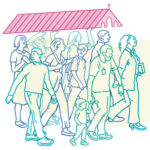
A lighter first meeting is a strategic choice to allow time for what comes next because, weather permitting, once a year board members take a prayer walk. In pairs or groups of three, they stroll the mature, tree-filled campus, pausing periodically to reflect and pray aloud.
“We have some Bible verses on plaques on big stones on the property,” Godwin said. “(Board members) spend the next hour or so, walking the site, including walking past these verses, and praying aloud for the organization and over the agenda for the next day.
“We give them something to guide them, Scriptures, and a map, and try to send them off in different directions so they don’t end up in the same place and congregate together.”
At the end of the hour, they come together again as a group and pray.
Saturday morning meetings begin with a devotional time, followed by an opportunity for board members to recite Scripture memory verses that the group is working on. It was a board member who first introduced the practice of Scripture memorization to the board using the Navigators’ Topical Memory System. Not everyone participates, but Godwin is reluctant to discontinue the practice, he said, because: “We’re supposed to be committed to the Bible, and I think it sets an important tone. We’re not just running a business.”
Every theological school board has plenty of business to attend to. And Godwin, who has been at Carey’s helm since 2013, recognizes there has been considerable “business operational pressure on the seminary world” in recent years. “It would be easy to forget that we have a spiritual mandate.”
Participating together in even the simplest of spiritual practices is one way of reminding board members that their work is also ministry, according to Rebekah Basinger, project director of the Wise Stewards Initiative, a grant-funded project of the In Trust Center, which seeks to enhance the governance effectiveness of boards of theological schools in North America.
Basinger estimated that since its inception, the Wise Stewards Initiative has worked with some 60 boards, about 10 or so each year. “Participation in the initiative gives boards the opportunity to work with a Wise Stewards coach on development areas specific to their needs,” she said. “We also encourage peer learning through monthly facilitated Zoom conversations and a twoday capstone seminar in March of their Wise Stewards year.
“Our goal is to help boards become the wisest possible stewards of the institutions they serve.”
Different schools have different spiritual practices, just like individual Christians do. But “the point, the purpose” of all Christian practices, according to Dorothy C. Bass, writing in the second edition of Practicing Our Faith: A Way of Life for a Searching People, is “a way of life” and especially, “a way of life abundant … in the midst of the ordinary stuff of existence.”
We give them something to guide them, Scriptures and a map, and try to send them off in different directions so they don’t end up in the same place and congregate together.
Basinger said there are close ties in many of the schools between the religious body the board serves and the trustees’ own religious lives. As a result, she said, the trustees “really see their work as supporting the church writ large, of helping to advance God’s purposes for the world.”
“This helps carry them through tough times,” she said. “It contributes to their courage and resilience, and it gives purpose to their work that you might not find quite as much in other settings.”
A practice that many of the schools have, Basinger said, is a chapel service before convocation, during which new trustees are commissioned or dedicated for their work. “It really is a touching ceremony. Depending on the school, it may be rather liturgical, in others it’s more free form.”
The power in the ceremony is that it happens in a public setting, where faculty and students see the board, Basinger said. “It really instills in the community the sense that these people aren’t here for their own glory. They are here to serve, and they are being commissioned for that particular work.”
Almost anything, when practiced consistently and with intention to the glory of God, can be considered a spiritual practice for individual believers and potentially adopted as a spiritual practice by a board. Fasting, forgiveness, hospitality, sabbath keeping, discernment, and singing are just a few examples. Basinger said another spiritual practice of most boards is generosity.
“The majority of board members give as generously as they can to their school. They are obviously giving generously of their time and opening their networks up to the school,” she said. “That’s just a trait of boards of theological schools, that spirit, that practice of generosity.”
And of course, prayer. Prayer does not have to be relegated to the opening and closing of meetings.
“I’ve been in board meetings where a board is working with a difficult issue,” Basinger said. “There might even be some dissension in the room, and all of a sudden someone will say, ‘Let’s pray about this.’ There will be a pause. Someone will pray for wisdom or a spirit of cooperation. I’ve heard people apologize for what they’ve just said.”
Godwin says that since many boards are composed of specialists who’ve been recruited for their expertise in various areas, it’s easy to fall into a pattern of “just doing business.” In other words, persisting in spiritual disciplines at the board level requires a certain amount of discipline.
“And there’s not always an immediate benefit,” he said. “But it’s really important, and it sets the tone. They are important for faculty and staff as well. The board can lead the way in this. Otherwise, what are we doing here?”