










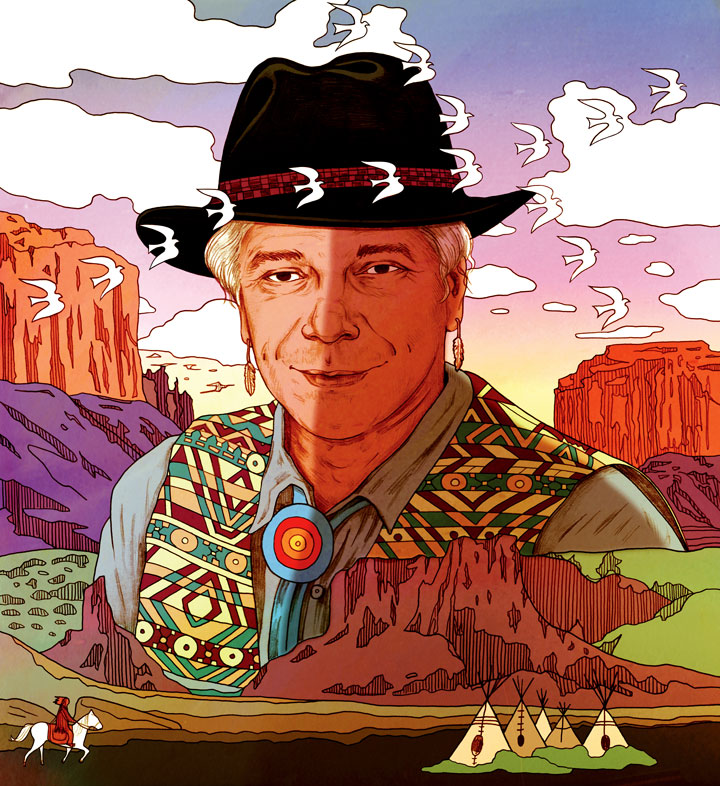
In the summer of 2026, Terry LeBlanc, Ph.D., traveled 2,300 miles from his home in the traditional Mi’kmaw territory of the Maritime Provinces of Canada (Mi’kma’ki) to Yellowknife in the Northwest Territories to officiate the funeral of a longtime friend. Dignified and precise, LeBlanc is a Mi’kmaw person; his friend was part of the Dene people, a First Nations people whose homeland for centuries has spanned Canada’s western subarctic, including much of the Northwest Territories.
“The Dene people have a culture that is deep and wide and has been there for centuries,” LeBlanc says. “So I’m officiating a funeral as a theologically trained and ordained clergyperson who is a follower of Jesus, serving in a context that’s not my own, for a friend whom I’ve known for decades.”
LeBlanc says that this multi-faceted role required helping those present to interpret death through both Dene tradition and Christian faith. “I go there and I ask: ‘Let’s talk about how this should look, rooted in your culture and traditions, with the gospel as a part of that interpretive framework. What would honor the deceased, the family, the community?’
“That approach expands the horizons of those who prepare and attend his funeral, to help them see that this is not an imposed understanding of what’s transpired but rather something interpreted in their context, as well as the context of the Gospel.”
His story is a metaphor for a collaborative project underway at NAIITS entitled Canadian Learning Community for Decolonization and Innovation in Theological Education (CLC). Supported by a Lilly Endowment Pathways for Tomorrow grant, CLC is, for NAIITS, a global collaboration that includes three institutional partners in Canada (Acadia Divinity College at Acadia University, Ambrose Seminary of Ambrose University, and Tyndale University and Seminary) to create a “learning community sharing a common ethos and mission for pastoral formation,” according to the grant application, including “curriculum development and pedagogies to address persistent barriers between Eurocentric Christianity and Indigenous North American adaptations of the faith.”
The CLC project is inspired in part by the troubled legacy of Christian mission schools, established in North America before becoming a church-state partnership through which clergy and the governments of both Canada and the United States pursued policies of Indigenous assimilation. A key component of both was the forced removal of Indigenous children from their homes to residential schools, and the depredations and abuse that sought to nullify their cultural heritage. The policies and practices lasted into the second half of the 20th century, when both governments ended compulsory residential education (the last school in Canada closed in 1996).
The repercussions persist, however, even after a formal settlement agreement that established Canada’s National Centre for Truth and Reconciliation Commission (TRC) and offered a spectrum of compensatory reparations. (The U.S. has investigated and apologized, but has not established anything similar.)
“When we use the words indigenization, contextualization, or for that matter decolonization, we’re saying that for the most part the development of theology, doctrine, and gospel-framed traditions took a European trajectory that Europeans would understand implicitly, but with the very explicit sense that all other cultures should comply,” says LeBlanc, co-founder and now director emeritus of NAIITS: An Indigenous Learning Community.
“Decolonization seeks to recover a Church in which many cultural histories may intersect the Cross and emerge culturally intact, while being transformed and engaged by the life and teachings of Jesus.”
NAIITS’ curriculum strives to unpack that for students as they study both the Hebrew text and the New Testament, LeBlanc says. “We’re asking them, ‘How do you read this set of stories written by these authors, telling an historical narrative under the inspiration of the spirit of God? How do you understand this? And how does this now intersect with and influence you as a Choctaw, as a Navajo, as an Ethiopian, as a Ghanaian?’”
The international scope of NAIITS led it to adopt a distributed education model, with NAIITS as the hub of a network of institutions and individuals delivering academic coursework online. Instruction is led completely online by a global faculty, offered in trimesters wrapped around an annual symposium. “We don’t have a building and don’t intend to have a building,” LeBlanc says. “We’ve said from the get-go that it’s possible to deliver meaningful education through multiple forms including virtual media.”
In conversation, LeBlanc frequently returns to the human consequences of colonization.
Decolonization seeks to recover a Church in which many cultural histories may intersect the Cross and emerge culturally intact.
Identity and Faith
For LeBlanc, the CLC project is a means to change institutions and revive Christianity’s promise to all people. For Jenn Mason, a 2025 graduate of NAIITS with a Master of Arts in Intercultural Studies, change is internal and intensely personal: an ongoing journey of discovering and combating racial prejudice, of resolving the loose ends of her childhood and young adult experiences as an outsider, and an awakening to – and struggle with – the legacy of the residential schools, scripture, and the Church.
A member of the Sagkeeng Anicinabe Nation, an Ojibwe First Nation in Manitoba, the 46-year-old stay-at-home wife and mother of four children (ranging in age from 14 to 20) is candid about her troubled childhood, protective of her family, and committed to facilitating human connection and community building.
As a teenager in the late 1990s, she says candidly that she was a bully, a posture she now recognizes resulted from her anger about prejudices she experienced as an Indigenous person. She dropped out of school, discovered gifts of both vocation and spirit, and found success as a financial officer with two prominent non-profit organizations. Eventually she earned her Manitoba Mature Student High School Diploma in 2010 at age 30 (that same year, she earned an accounting certificate from Red River College).
“My husband went to an Indian Day School, and then a residential school,” she said. “The government no longer boarded them, but it was the same type of experience. So for both of us, school was very, very traumatic.”
“In every iteration family is obliterated,” Mason says, “and there’s no chance to learn how to parent. That’s still life for us. And, unfortunately, the (United) States is farther behind in terms of talking about things.
“And so when it came time to put our own kids in school, it was terrifying. Even though it was a stretch and a sacrifice, we put them in a private Christian school because it was small, because they would have community, and they would be known rather than be the brown face in the corner. We do our best to teach them at home to be proud of who they are.”
Mason’s tentative steps toward stilling the swirling currents of her life ultimately led her to NAIITS to pursue a Master of Arts degree in Intercultural Studies, which she completed in 2025. She had been working closely with Wendy Peterson, one of NAIITS’ founding members, who encouraged her to pursue coursework there. Peterson died suddenly in 2018, and at her funeral, LeBlanc urged Mason to honor Peterson by becoming a student.
“How could I say no to that?” she said. “Going in, I had no aspirations. I didn’t know what it was that I was after. I just knew that the hand of God was upon it. My time at NAIITS helped me to find words for what I was, what life was. I found some permission to just love Jesus exactly the way that I thought that I was supposed to, not worry about trying to check off somebody else’s boxes and realizing those boxes can’t work for me anyway.”
Today, Mason is bringing her newly informed understanding and her graduate education to others as an adjunct faculty member at Providence University College, teaching an introductory course in Indigenous Studies.
“I try to let people know you cannot put a box around the work of learning and understanding. There’s call to accountability, but in love and in relationship. I never imagined that what I would get from it would have so much to do with my own identity and faith.”
Justice, culture, belonging
Kirsten Schmaus and Laura Bevan Alexander reside 1,700 miles apart, but share a critical role as CLC educationalists, positions that serve as conduits between NAIITS and its institutional partners. In their work to foster faculty relationships, institutional conversations, church connections and community partnerships at the sites where the CLC operates, they bring distinct points of view: Schmaus is motivated by justice and moral awakening, while Alexander’s concerns are identity, culture and belonging.
Bevan Alexander is working half-time as coordinator for the Centre for Pastoral Imagination and half-time as the educationalist at Tyndale University in Toronto while pursuing a doctoral degree with NAIITS. Schmaus is pursuing a second bachelor’s degree from Ambrose University in Calgary.
Neither has roots in Indigenous cultures, yet both exhibit receptivity as well as expertise. And both have discovered that engagement with Indigenous perspectives compelled them to reconsider assumptions they had once taken for granted.
“I’ve learned how important it is to be uncomfortable, and what it means to be a settler Canadian engaging with reconciliation conversations,” says Schmauss, who holds a B.A. in History from the University of Alberta and is pursuing a second bachelors degree in education to be certified to teach K-12.
Raised in Calgary, Schmaus was unfamiliar with the work of the Truth and Reconciliation Commission (TRC) until she encountered it at Ambrose, she says.
Reading Richard Wagamese’s celebrated 2012 novel Indian Horse, the story of an Ojibwe boy who survives the residential school system and the trauma it induced, volunteering in a criminal justice system over-populated by Indigenous people, and fundraising for anti-human trafficking (Indigenous women comprise half of the cases in Canada, despite representing just 4 percent of the population), further sparked her interest.
For several years after earning her bachelor’s degree, she worked in the bookstore at Ambrose, where she first learned about the seminary’s partnership with NAIITS’ CLC and was elected to the staff committee. She took a class in intercultural competence and extended her own learning to the staff council, utilizing videos provided by NAIITS for seminary faculty, along with their discussion questions, as foundations for discussion.
“It means that for the first time, I’m uncomfortable and they (Indigenous people) are comfortable. Or maybe not; it’s hard work for them, too. There have been uncomfortable conversations, and they’ve just shaken things up and made me re-examine some of what I long held as foundational.”
A safe place to ask questions
Laura Bevan Alexander was born in Ireland and, as a young child, moved with her family to a town about five hours north of Toronto, where the family attended a Canadian evangelical church. The family interacted with a First Nations community, attending powwows and other Indigenous activities in the region. After the family moved to Toronto, there were few interactions with the Irish diaspora community, she says. Her parents had left the Catholic Church as young adults just prior to emigrating (part of a general cultural movement away from the Church in Ireland), and joined a Pentecostal congregation.
“We still spent a lot of time in Ireland,” she recalls, “and so that was quite a gift. But as I got older, I was always asking questions about the Church; I wondered why that was something that wasn’t so valued for us.”
She earned an M.Div. from Tyndale University in 2023 and is currently a NAIITS educationalist embedded at Tyndale. She also serves as coordinator for the Tyndale Centre for Pastoral Imagination, while working on her Ph.D. from NAIITS. (Her dissertation is a study in Irish faith.)
“I saw this community of people who were able to hold their culture and their faith and value both of them. This kind of investigation was being practiced all around me, but it was more than that: It was also this sense that this is important work, something valuable for a person of faith to have that knowledge of and connection to culture and place and land.”
Alexander notes that the evangelical tradition of her youth was opposed to a contextualized faith, that it was too close to paganism, and although she wanted to ask questions she “had quite a fear … in the native community I had this safe place to start asking questions.”
I’ve learned how important it is to be uncomfortable, and what it means to be a settler Canadian engaging with reconciliation conversations.
Nmultis (See you again)
Back in Yellowknife, LeBlanc saw decolonized theology expressed not in a curriculum but in the ceremony and care for family at the time of his friend’s death. Following Dene tradition, the sons built the coffin, washed the body, and prepared it for burial; then they helped dress their father. Death was neither sanitized nor removed. Grief, celebration, Dene tradition, and Christian hope occupied the same space.
For LeBlanc, this is the work NAIITS hopes theological schools can learn to undertake: “How do I enter that space and understand the culture and traditions of other people, instead of presuming ‘This is the way you do a funeral.’”