











By Rick Staisloff, Senior Partner, rpk GROUP, a division of MGT Impact Solutions, LLC
In Spring of 2026, four senior leaders in theological education were invited to gather on a panel as part of the P3EDU MAP Summit. Sharing their experiences that day were Jeff Carter, President of Bethany Theological Seminary; Greg Henson, President of Kairos University; Amy Kardash, President of the In Trust Center for Theological Schools; and Frank Yamada, Executive Director of the Association of Theological Schools.
“MAP” refers to “mergers, affiliations, and partnerships” in higher education. The subject matter experts who gathered in Virginia brought expertise and interests across the full breadth of higher education innovation.
The text below captures the discussion during the panel session. Content has been edited for length and clarity.
Staisloff: Let’s kick things off. Why do the changes facing theological education today make strategic partnerships necessary, and why is this the right moment to pursue them?
Kardash: We currently lack alignment among mission, governance, and people in theological education. It is a myth that just because these are theological institutions, they automatically have clear alignment in this regard.
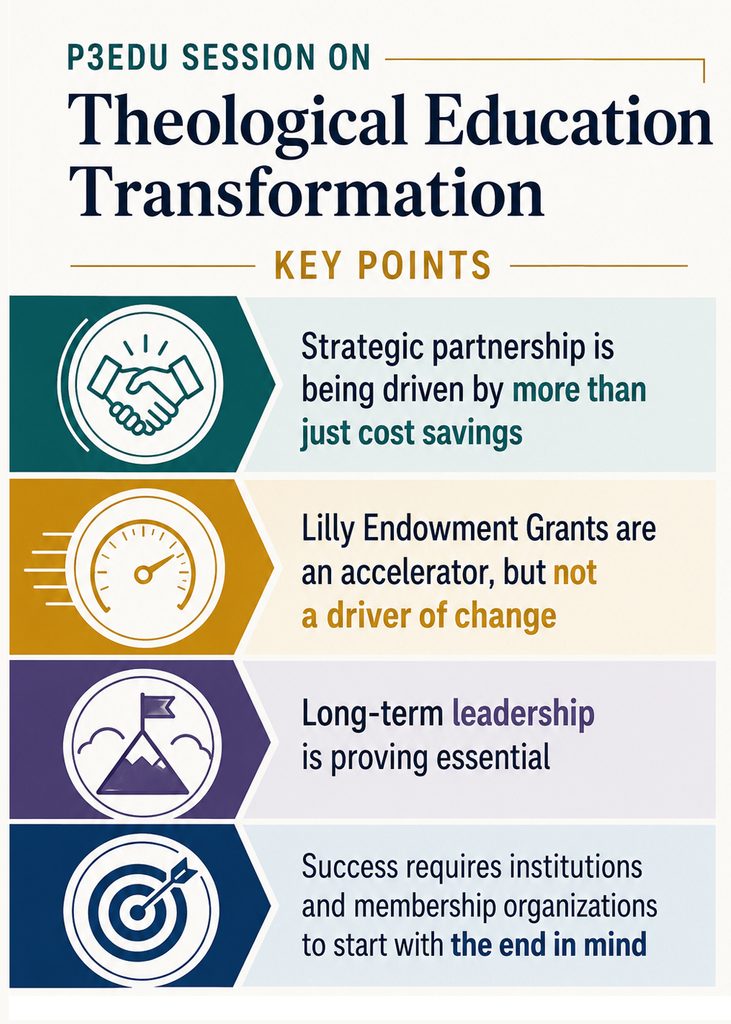
Henson: Agreed. And I would add that the change, which is needed, and the end goal for a strategic partnership, has to extend beyond just cost reduction.
Yamada: In many ways, the effort here is to reconnect a fragmented ecology that has seen institutions operate in isolation for too long. They are not as unique as they think they are.
Staisloff: If the focus can’t just be about cost savings, how does the business model and good financial stewardship fit in here?
Henson: First of all, we have to recognize that this isn’t a function of collaboration vs. competition. The primary competitor to seminaries is not other seminaries; it is people not participating in theological education at all.
Yamada: In a real way, we are all facing a values gap. Meaning, what value is theological education bringing, and how well does this match up to the needs and wants of students and the organizations that will eventually hire them?
In a real way, we are all facing a values gap. Meaning, what value is theological education bringing, and how well does this match up to the needs and wants of students and the organizations that will eventually hire them?
Frank Yamada, Executive Director, ATS
Staisloff: The work of strategic partnership is being supported, in part, through grants by the Lilly Endowment. What’s the intent of those grants?
Kardash: Well, the grants from Lilly, while absolutely generous, should be seen as an accelerator to change, but not the driver of change.
Yamada: Agreed. Lilly is best seen as a learning hub. They are creating a common learning culture.
Staisloff: So what’s the reaction been among theological institutions to the focus on strategic partnership?
Henson: We’re thirteen years into doing this. From the start, it was less a concern about collaborating and more a concern about how to collaborate. We now have a conversation about partnership with a new partner at least weekly. And that partnership dynamic has become the primary driver of our enrollment growth and our financial sustainability.
Carter: When he first talked about partnership at my institution, everyone went into a loss mentality. They focused on what we’d be giving up. That signaled to me that we needed to change our culture. The very best advice I received was from a former college president who told me “You don’t change culture, you hire culture.” That started us down a process of change management focused on recruiting and retaining new leadership.
Staisloff: If we’re talking about change and change management, I think we have to almost immediately go to the topic of leadership. How are you attempting to support needed change?
Kardash: This work takes time. It is based on relationships. And ultimately requires a change in mindset. What makes Greg and Jeff so successful in this work, in part, is the amount of time they have spent in their leadership roles. I find that I’m now shifting my language in working with governing boards from the need to “hire, care for, and support executive leaders” to “hire and keep”. For collaboration to take hold, for transformation and organizational culture shift to take place, you need that long runway.
I find that I’m now shifting my language in working with governing boards from the need to “hire, care for, and support executive leaders” to “hire and keep”
Amy Kardash, President, In Trust Center
Yamada: The average tenure of an ATS executive is just over five years right now. And that tracks with some of higher education’s numbers. If a board thinks it is just managing a crisis, you might be able to get by with an interim president. But if you’re looking for transformative change or innovation or sustained partnerships, you’re going to need a president in place for at least seven years.
Staisloff: So, in a few words, if you’re all successful, what will good look like for these transformations?
Kardash: We’ll become even more faithful stewards of resources.
Henson: The internal muscle building will have happened that supports the external work, and allows for needed collaboration to happen intentionally.
Yamada: We’ll have fewer schools that are “independent fiefdoms”, but not necessarily fewer schools.
Carter: We’ll have the leadership in place that can move toward needed change.