











The Reverend Laurie Clark, 36, an associate pastor at Maple Grove United Methodist Church in Columbus, Ohio, and a 1994 graduate of Duke University Divinity School, has agreed to a late interview, and our conversation, punctuated occasionally by her 17-month-old daughter’s cries, carries the rambling intensity of a late-night philosophical discussion.
By her own admission, Clark was surprised by how well her seminary prepared her for the work she encountered once she entered ordained ministry, and her themes were those I heard repeated by the others interviewed, that, at heart, the rigorous intellectual and spiritual formation she received—the ability to “think theologically” —undergirds every aspect of her parish life. Seen in retrospect, it is now clear to her that “prayer really was study and study really was prayer,” and she marvels at the experience in which she was “shaped fifty years beyond” where she would have been if she’d remained an active layperson. “It was really intense; it was awesome.”
But when it comes to how her views as a younger minister, relatively new to her role, might differ from those of her older colleagues, her voice bristles with the angry eloquence generally reserved for pet peeves: “What I hear from people over 50 is all these complaints about seminarians who don’t know how to do practical stuff.” She continues, exasperated, “I can teach a seminary student how to marry, bury or baptize in twenty minutes. . . . I learned all I know on stewardship stuff in one- or two-day seminars. The role of seminary is to teach you what it means.”
In today’s church, the interplay between the different perspectives of Boomers, those in their 50s and Generation X-ers, those 20 to 35 or so, creates a new dynamic for leadership whose expression is twofold. Seminarians approach thosewho would educate them with extremely open minds, asking to have their worldviews shattered and seeking the core Christian message—whether it’s one they agree with or not—along with the spiritual formation that results as they experience the theological immersion seminary provides. There is an almost childlike willingness to put themselves in the hands of their elders and say, “Form me.” Yet for many, once they enter ordained ministry, that openness manifests as a completely different relationship with authority—their own and that of the church—and nowhere is this more true than with ordained women.
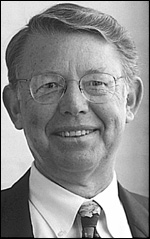 |
| David Kelsey, a professor at Yale University Divinity School, is a long-time student of theological education. |
David Kelsey, a professor of theology at Yale University Divinity School and author of To Understand God Truly: What’s Theological about Theological Education?, wonders, however, if this “friend instead of authority” approach isn’t “totally unreal.” In an interview recently, he pointed out that ministers are “almost automatically the targets of a kind of ascribed or projected authority—they can be buddies all they want to, but they’re going to have things laid on them they aren’t expecting.” In the young clerics’ embracing of interpersonal authority, Kelsey hears an echo of what has been tagged in theological education circles as the “systems view” of analyzing how an organization works. He wonders if, however naively, these new ministers haven’t found healthy middle ground. “When you analyze an organization [from a systems view],” he said, “you come to see that the most effective way to exercise leadership authority is not in terms of a top-down command model, nor simply a ‘I’m-your-friend-trust-me’ model, but, with a fair amount of self-understanding, learning how the system works and—let’s face it—how to manipulate it.”
 |
| The Reverend Meg O’Brien baptizes Will Hawk, 18, in a pond in Keezletown, Virginia, during a retreat in September 2002. |
The Reverend Meg O’Brien, 35, of Community Mennonite Church, Harrisonburg, Virginia, and a 1997 graduate of Fuller Theological Seminary, Pasadena, California, spoke to the contrary. “I think people want authenticity more than they want authority,” she said. In her view, pastors have fallen from their pedestal as parishioners lose their trust in the powers that be. While she sees this as a crisis of leadership in the culture at large, she also finds a sign of hope. “There’s a lack of trust of authority, but then there’s a resurrection, of giving authority to pastors for different reasons,” she said.
The Reverend Brandi Drake, 34, of Grace Presbyterian Church (PCUSA) in Montclair, New Jersey, another Fuller graduate (in 1996), contrasted what she referred to as her “transparent” leadership style with that of her senior pastor, a Baby Boomer who embraces the authority inherent to his expertise. They even joke about it: “We say he’s the transcendent pastor and I’m the immanent,” she laughed.
Either way, there is a new breed of ministers out there, men and women who go to seminary to seek the essential, from their faith and within themselves, and who, as they enter congregational life, feel called to witness to the truths of their denominations only as they’ve been borne out in their lives. “As I see it, my role is to walk with them [the parishioners] and not try to fix them,” said Christa Klosterman, 25, of Kolapore Church of the Nazarene in Kolapore, Ontario, a 2002 graduate of Nazarene Theological Seminary, Kansas City, Missouri. Klosterman feels that women are better prepared to fill this new role because historically they’ve never held the reins of power and are thus less invested in its use.
This is in no way a rebellion. To a person, those interviewed embraced their church’s mission and glowed when describing their seminary days. The Reverend Clint Dowda, 32, an associate pastor at the Redeemer Presbyterian Church (PCA) in Winston-Salem, North Carolina, stressed that the greatest gift of his tenure at Westminster Theological Seminary, Philadelphia, Pennsylvania, was the ability to “think theologically,” repeating a phrase heard again and again over the course of interviews. In his view, in a less hierarchical church where strugglers are more welcome, addressing the specifics of his ordained ministry, while useful, was far less important than the long-term approach to formation he received in seminary. (Dowda was awarded his M.Div. in 1998.) For him, the equation is clear: the less emphasis there is on pastoral authority, the more emphasis there is on God.
The self-knowledge won in seminary was also cited as critical to this newer more interpersonal approach to authority. O’Brien, who remarked that the only thing that could make her more challenging to her congregation would be if she were a lesbian, and the Reverend Robert Capone, 33, of Holy Family Roman Catholic Cathedral in Orange, California, a 2000 graduate of St. John’s Seminary, Camarillo, California, and a man very comfortable with the traditions of his church, both spoke with great conviction on the importance of self-knowledge, particularly of one’s dark side, seeing it as essential to ministry and a crucial part of their formation in seminary. It’s also what plays with overscheduled and highly mobile parishioners who want to relate with them as individuals. They “want to belong before they believe,” said the Reverend Brent Peterson, 28, of the First Church of the Nazarene, Kansas City, Missouri, a 2000 graduate of Nazarene Theological Seminary. He finds that congregants generally “don’t leave churches because of theological differences; they just want to be loved,” and seeks to nurture them through “testimony, not authority.”
As members relate to the church more and more as a flattened hierarchy, two contrasting trends emerge. Drake spoke of stressed, overscheduled lay people who are “coming to church but not necessarily joining, which makes it really challenging for us to find leaders.” Because of this, it’s much more difficult to relate to the congregation, especially youth, programmatically. “It’s a much more relational, one-on-one ministry.” Kathy Kelleher, 29, a graduate of Catholic Theological Union in Chicago, is a project manager for Claretian Associates, a nonprofit community development corporation founded by the Claretian Missionary Fathers. She sees a different trend, repeating a statistic cited often by the Reverend Donald Senior, CTU’s president. “Two years ago, there were about 3,000 Catholic seminarians studying for ordination in the U.S.,” she said. “At the same time, there were about 35,000 lay people studying for the same professional degrees—over eleven times as many Catholic lay people studying for professional ministry in the church. God’s Spirit is moving people in place for something.”
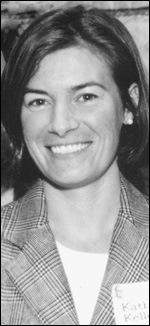 |
| Kathy Kelleher, who earned her M.Div. at Catholic Theological Union in Chicago, Illinois, is among the growing number of Catholic laity who pursued theological education without the chance of ordained ministry. |
Kelsey, the Yale professor, does not see this phenomenon as unique to the Roman Catholic Church. “In many of these schools, there is a substantial minority of the student body that does not see itself going into ordained leadership roles in religious communities,” he said. “Seminaries aren’t paying enough attention to the specific kinds of questions and issues of that subpopulation—they treat them all as though they were going to get ordained when many of them know they’re not—and the peculiar questions that a person has who will in another year be back at the nursing station or the high school classroom or the office while being very self-conscious about their identity as really highly theologically trained layperson. Those questions aren’t being focused on.”
Seminary is also a place where mistranslations of denominational truth are repaired. Chris McCullough, 38, coordinator for adult faith formation at the Catholic Cathedral of St. Matthew in Washington, D.C., found in his M.Div. program at the Washington Theological Union (he graduated in 2000) a new understanding of the truth and the beauty of the church and his own position within it. “I grew up in a very traditional, somewhat conservative parish, which was kind of top-down and heavy-handed. But entering seminary was in some ways my making my Catholicism my own—my ‘Aha!’ moments were, ‘so that’s why it’s that way,’ or, ‘that’s not what the church really teaches, this is what the church teaches,’ which led to a kind of inner authority.”
Inevitably, structure fails to channel the movement of the Spirit, and if seminaries don’t embrace the yearnings of their students, students find ways to address them on their own within that structure. The Reverend Robert Mitchell, 24, a 2002 graduate of Wycliffe College in Toronto, who divides his time among All Saints’ Anglican Church in Toronto and two other parishes in rural Ontario, felt well prepared by his seminary, especially for the more practical aspects of his ministry. But he regrets that he wasn’t given a theological template for addressing the issues of the day. He’s also very clear on the most engaging aspect of his training. “A lot of my learning, to be honest, went on in those conversations I had after class and in the halls late at night with my friends and other residents,” he said. “I was really stretched and grew a lot through that experience—more than I did through my class work.”
This mirrors the experience of the Reverend Matt Kuempel, 29, pastor of Good Shepherd Lutheran Church, Washington, Kansas, and Zion Lutheran Church, Hollenberg, Kansas, a 2002 graduate of Luther Seminary in St. Paul, Minnesota. “None of the formal pieces that were established by seminary for formation were helpful,” he said. “The most significant, helpful part, for me, was living with my fellow seminarians.” Kuempel also expressed frustration at what he saw as his seminary’s inability to think outside the box. “I think one of the reasons the formal element didn’t work as well for me was that they seemed to have a particular model for the way of being a pastor and the way of being a Christian in mind—formation, not in the growth sense, but like a squishing into a Play-Doh mold.”
In September, Kuempel was ordained by a Lutheran pastor who was not a bishop—an exception to rules governing the ELCA’s full communion relationship with the Episcopal Church, and an act of conscience that speaks eloquently to his relationship with church authority. “Pastoral authority comes much more in the preaching of the gospel, the giving of Christ’s benefits to people, and forgiving sins rather than trying to exercise any kind of control over folks’ lives,” Kuempel said. “I don’t think about the church in terms of authority . . . at all, really.”
The Reverend Kristin Kuempel, 27, Matt Kuempel’s wife, who is also a 2002 graduate of Luther Seminary and who spreads her time among three other Kansas congregations, shares her husband’s ecclesiology. Nonetheless she opted for a regular ordination. “It wasn’t an easy decision for either one of us,” she said. “It involved a lot of prayer and a lot of seeking counsel of people we trusted, and slowly over time I came to realize that it wasn’t the road I was meant to walk down. I knew it was going to be a fight, and I just didn’t have the stamina. It was one of those things where it was just easier to give in and do what they wanted than to try and put myself out there.”
Kristin Kuempel also sees herself as different from her older colleagues. “I’m a little more relational and a whole lot more relaxed,” she said with a laugh. “This area has a lot of retired pastors who are still active because of the clergy shortage. . . . They’re all ‘Pastor Last Name’—even if you are a colleague—and there are very clear and definitive lines drawn around their pastoral office. I am the first pastor in most of my congregations who’s let them call me ‘Pastor First Name’ and some of them even call me by my first name. I don’t need to be constantly called Pastor Kuempel to affirm my identity as pastor.” She’s quite clear in her approach to ministry. “I’m very interested in getting to know my people on a personal level,” Kuempel said. “I want to build relationships with them so that I know what word they need to hear from the pulpit, so that I know where they’re struggling and where they’re not, and where they’re scared, their hopes, their joys. I want to know that so that I can bring a very specific word from God to them.”
As theological schools have moved, however unconsciously, away from the skills-based approach of practical ministry favored in the mid-1970s, Kelsey is pleasantly surprised that seminaries seem to have stumbled upon the formula that has worked so well for these M.Div. graduates, the core curriculum of academic theology and the structuring of community life. But he stresses the importance of now systemizing the approach. “I think it needs to be kept in mind that what works as the right mixture for ten years may not work for the next ten. For all of the praise of the academic core, I still wonder whether theological education has thought through clearly enough how the specific academic disciplines gear in with the ground-level practices that make up the common life of religious community—educating the young, taking care of people in need, conducting services of worship, explaining what the tradition means—practices so commonplace and widespread that they’ve become virtually invisible.”