









MAGAZINE
How to hatch a story

Boards and leaders of theological schools need to consider the story they’re telling the world. Matt Hufman, vice president for communications and publisher at the In Trust Center, offers this guidance.
Stories left unattended can drift or disappear entirely. Too often, institutions produce well-intentioned messages that never connect because they aren’t rooted in a clear, shared understanding of mission.
Hufman reminds leaders that the challenge isn’t a lack of stories, but a lack of alignment. In a crowded communications landscape, the mission, not the medium, must remain the message.
He encourages leaders to focus on four essential questions: What do we actually do at our core? How are we truly perceived by others? Do our actions consistently reflect our mission? And what is the unique story only our institution can tell?
When institutions ground their storytelling in these questions, communication becomes less about promotion and more about faithful expression. A clear, coherent story doesn’t just inform; it reflects the very reason the institution exists.
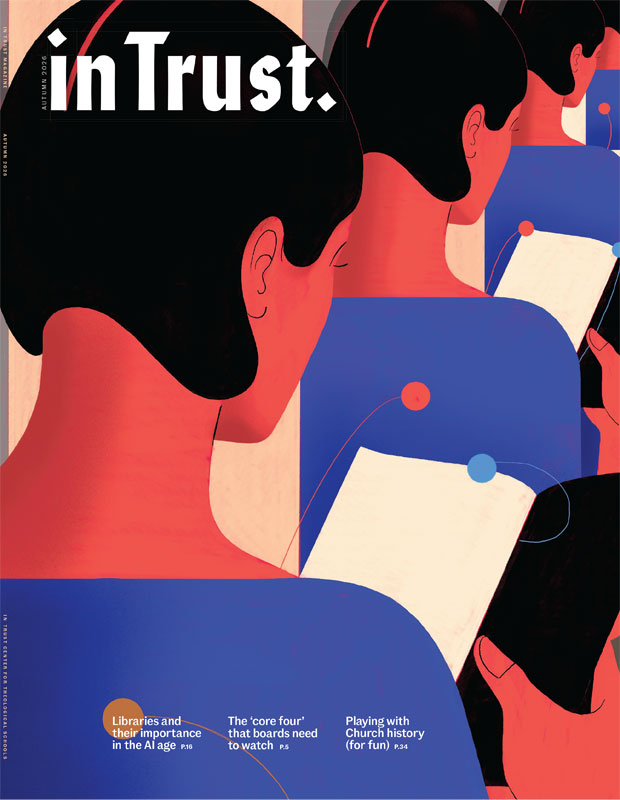
Read the article in the Spring issue of In Trust magazine here.
What do you think? Email us here with your thoughts.
Also, in the Spring 2026 issue of In Trust:
- Reflecting in an AI world. A new initiative at the University of Notre Dame, funded by Lilly Endowment Inc., is exploring how faith can guide the ethical development of artificial intelligence. Led by Meghan Sullivan, the project centers on the DELTA Network, which brings together educators, faith leaders, and technologists to promote human flourishing. Grounded in values like dignity, love, and agency, the effort moves beyond technical concerns to address deeper questions of meaning, responsibility, and the common good. This article expands on themes discussed in Ep. 104 of the Good Governance podcast listed below. Read “Reflecting in an AI world” here.
- The Big Issue. Theological schools facing enrollment pressures and cultural shifts may need to look beyond program innovation or marketing strategies. Leadership consultant Aaron Einfeld suggests the deeper challenge is loss and notes that people often resist not change itself but the vulnerability it brings. He cautions that institutions can miss underlying issues by focusing only on surface-level challenges, filtering out evidence that doesn’t fit existing assumptions. For theological schools, that may mean reexamining long-held models of education in light of students’ realities and the evolving needs of ministry. The task for boards and leaders, Einfeld emphasizes, is both strategic and pastoral: to name what is being lost and help their communities move through it with clarity and care. Read “The Big Issue” here.
Did you get your magazine? If you’ve moved or don’t receive In Trust magazine (a magazine subscription comes with your membership to the In Trust Center for Theological Schools), you can update your information or ask to be placed on the magazine list by emailing us.
Full issue: You can read the Spring 2026 issue of the magazine on the website here.
PODCAST
Ep. 105: Finishing faithfully – leadership lessons on closing a school
What does it mean to finish well?
The Rev. Dr. Colleen Derr reflects on one of leadership’s most difficult responsibilities: knowing when, and how, to finish well. A former seminary president, Derr draws on her experience leading Eastern Nazarene College through its final chapter and offers a candid and hopeful perspective on institutional closure. She shares the realities of financial distress, the weight of inherited decisions, and the emotional and spiritual complexity of guiding a beloved institution to its end. The story is one of faithfulness to stewarding the final chapter well. Derr highlights the importance of mission clarity, courageous leadership, and honoring people over place. For leaders navigating uncertainty, this conversation provides both practical insight and a deeply human vision for ending with integrity and purpose. Listen to Ep. 105: Finishing faithfully – leadership lessons on closing a school here.
Other recent episodes include:
- Faith and formation in the AI age. In this episode, Dr. Meghan Sullivan of the University of Notre Dame explores how AI is already transforming human experience and why this moment demands ethical and theological engagement. Drawing on new work funded by Lilly Endowment Inc., Sullivan introduces the DELTA framework to help leaders think clearly about human flourishing in an AI-driven world and encourages Christian leaders to move toward thoughtful, hope-filled engagement. She highlights the risks of outsourcing human formation to technology while also pointing to new opportunities for theological education to meet a growing cultural hunger for meaning, purpose, and spiritual depth. For a deeper look at this work, see the companion article “Reflecting in an AI world” noted in this newsletter’s magazine section. Listen to Ep. 104: Faith and formation in the AI age here.
- Leading through deep change in a shifting landscape. In this episode, Aaron Einfeld, Ph.D., explores how institutions can misinterpret current realities by relying on outdated assumptions about formation. While demand for rigorous theological training remains strong, traditional models are often inaccessible in today’s context. Einfeld highlights the difficulty of organizational change and encourages schools to rethink their role, not just as degree providers, but as lifelong partners in developing ministry leaders. As churches seek more contextually grounded leadership, a gap is emerging between what seminaries offer and what ministry requires. Though the path forward will involve difficult change, including revisiting institutional identity, renewal is possible for schools willing to reimagine their purpose. Listen to Ep. 103: Leading through deep change in a shifting landscape here.
- An inflection point for theological education and an opportunity to lead. As federal policies continue to reshape higher education, leaders of theological schools are facing new challenges and new opportunities. In this timely conversation, governance expert David Rowe and higher education law scholar Peter Lake explore what shifting regulations, funding pressures, and cultural debates mean for boards and presidents today. From mission and accountability to accreditation and public trust, this discussion offers practical guidance for leading with clarity and resilience. Discover how institutions can move beyond compliance to strengthen strategy, communicate their value, and stay grounded in their mission in uncertain times. Listen to Ep.102: An inflection point for theological education and an opportunity to lead here.
STRATEGIC SHORTS
Large-scale Collaboration and Difficult Personnel
The Strategic Shorts video series delivers practical, timely insights to help strengthen institutional leadership. In this episode, “Large-Scale Collaboration and Difficult Personnel Decisions,” the conversation focuses on how institutions can navigate staffing challenges that emerge in collaborative efforts. Key takeaways include aligning personnel decisions with long-term goals, conducting thoughtful talent assessments, and planning strategically to balance efficiency and productivity. Host Dr. David Rowe, Audrey Hollingsworth, Chief Human Resources Officer for the W.C. Bradley Co., and Susan Deniker, labor and employment attorney at Steptoe & Johnson, PLLC, emphasize the importance of early legal guidance, consistent policy review across partner institutions, and clear, transparent communication throughout periods of transition. They offer valuable guidance for leaders approaching complex organizational changes with integrity and foresight. Watch the full conversation here.
INITIATIVES
“A Gift from Heaven”
Those are the words of a participant describing the Wise Stewards Initiative, a governance initiative for theological school boards to create space for innovation and maximize board potential, reimagine governance as an agent for change, enhance the president-board partnership, and clarify roles and responsibilities. Participating schools have access to a comprehensive board assessment, one-on-one consultation with a governance expert, tailored resources, and cohort-based peer learning opportunities. All In Trust members are eligible for this free opportunity. Learn more and apply today at intrust.org/WSI.
SPONSORED
Introducing the ACEO Health Plan
AdminWise Shared Services is pleased to introduce the Association of Church Educational Organizations (ACEO) Health Plan, an exclusive health insurance option for ATS seminaries and church-related colleges. This sustainable, cost-effective solution helps institutions address rising employee health insurance costs while continuing to offer competitive benefits. Participants benefit from greater flexibility, reduced regulatory burden, subsidies, enhanced bargaining power, and shared governance to ensure institutional needs are met. Learn more at www.adminwise.org or contact ron.ringenberg@adminwise.org | 574-370-0345.