









When Gerry Turcotte became president and principal of St. Mark’s College at the University of British Columbia in 2022, Registrar Emil Canlas mentioned that he’d really like to have a mace, the traditional symbol – with roots in medieval Europe – of a school’s authority.
“I thought that was a pretty easy issue to address,” said Turcotte, who had previously commissioned a mace for St. Mary’s University in Calgary when he was president there. As Turcotte considered a mace for St. Mark’s-Corpus Christi, he also had in mind the recent papal visit to Canada.
Earlier in 2022, Pope Francis had apologized to survivors and families of former students at Indian Residential Schools for the Church’s role in operating the schools, and the trauma it created. In his apology, Francis said, “It is my hope that concrete ways can be found to make those [Indigenous] peoples better known and esteemed, so that all may learn to walk together.”
Turcotte wondered if the mace for the Vancouver-based Catholic schools could be one of those concrete ways – an authentic act of reconciliation. He connected with Chrystal Sparrow, a prominent Salish artist from the Musqueam First Nation whose work graces Vancouver City Hall and the British Columbia Children’s Hospital. After she accepted the commission, Turcotte had another idea: Would she consider carving it in community? Sparrow agreed.
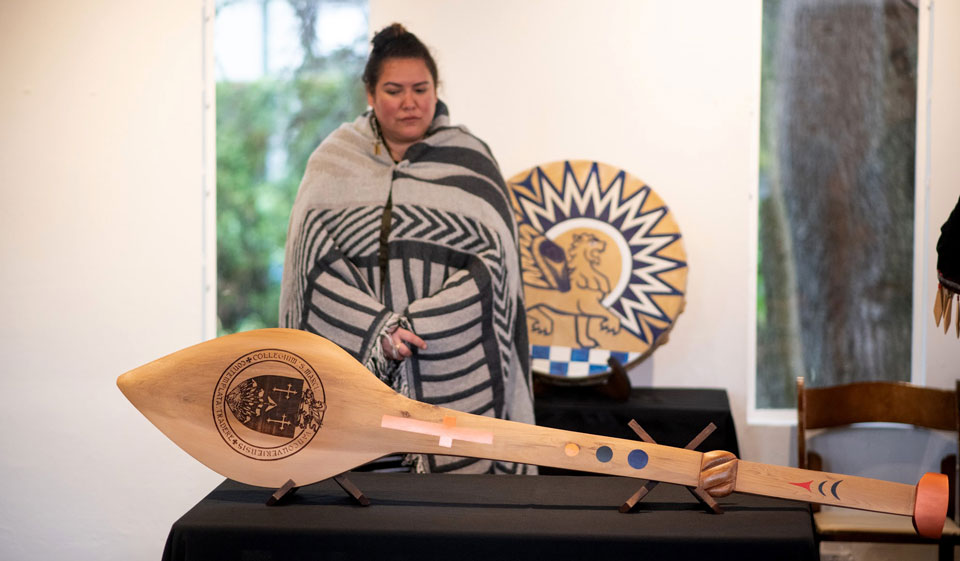
In September 2023, members of the faculty, staff, and student body gathered to each carve a bit of the five-and-a-half-foot piece of cedarwood; Sparrow then refined their work and completed the mace. It is in the shape of a canoe paddle to symbolize moving forward, and it features the winged lion – the historic symbol of St. Mark – as well as a carved rope design that represents the intertwining of the schools and the Musqueam community.
Symbols are beautiful, but if they don’t lead to active change, then they’re just decoration,” Turcotte said. The schools are continuing to make changes that connect with the Musqueam community.
The finished mace was unveiled in 2024 around National Indigenous Peoples Day. It has been used at formal events and a ceremony celebrating St. Mark’s 70th anniversary in September. When it’s not in use, it’s on display in the college’s main gathering area.
“Symbols are beautiful, but if they don’t lead to active change, then they’re just decoration,” Turcotte said.
The schools are continuing to make changes that connect with the Musqueam community; for example, they are in the process of incorporating both Musqueam and Christian imagery into the regalia of the president, the board chair, and the chancellor, the archbishop of Vancouver.
“Today, more and more of our initiatives are focused on building friendships, community, and conversations,” Turcotte said.