







MAGAZINE
AI Libraries.
Rethinking the seminary library in a new era of AI.

As artificial intelligence transforms research and learning, theological libraries face new challenges and opportunities.
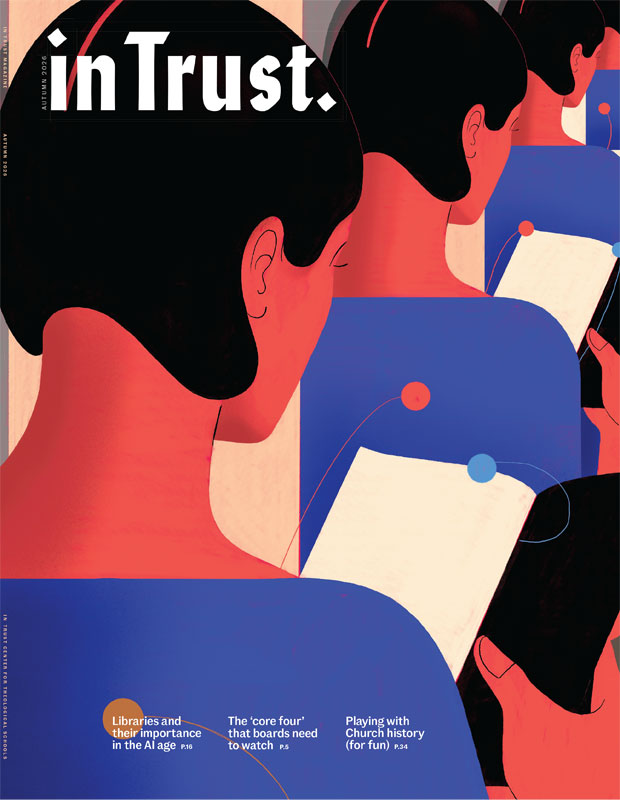
Seminary libraries are evolving from repositories of books into essential centers for research, information literacy, and responsible AI use. This article explores six key considerations for theological school leaders, emphasizing the growing importance of librarians in helping students and faculty evaluate sources, preserve unique collections, and navigate emerging technologies. The challenge for institutions is not simply to rethink their libraries, but to ensure they continue supporting scholarship, critical thinking, and theological formation. Read AI Libraries: Rethinking the seminary library in a new era of AI here.
What do you think? Email us here with your thoughts.Also, in the Autumn 2026 issue of In Trust:
- The ‘Core Four’. What measures matter most in assessing a theological school’s effectiveness? New research from the In Trust Center’s Governance Initiative identifies four key indicators linked to mission fulfillment and economic vitality: student-to-faculty ratios, CEO turnover, student persistence rates, and annual budget surpluses. Drawing on data from 192 ATS-accredited schools, the findings offer boards a research-based framework for tracking institutional health and making informed decisions. Read The ‘Core Four’ here.
- Why Boards Engage in Spiritual Practices. Board meetings often focus on budgets, policies, and institutional challenges, but spiritual practices can help trustees reconnect with the deeper purpose of their work. From prayer walks and Scripture memorization to worship and intentional reflection, theological school boards are finding ways to strengthen relationships, encourage discernment, and remain grounded in their missions. Read Why Boards Engage in Spiritual Practices here.
Did you get your magazine? If you’ve moved or don’t receive In Trust magazine (a magazine subscription comes with your membership to the In Trust Center for Theological Schools), you can update your information or ask to be placed on the magazine list by emailing us.
Full issue: You can read the Autumn 2026 issue of the magazine on the website here.
PODCAST
Ep. 113: Measuring what matters: Effective evaluation
How can theological schools move beyond enrollment numbers and traditional metrics to measure meaningful impact?
Host Matt Hufman welcomes Kay Edwards and Mary Reinders of Outsight Network to explore how assessment and evaluation can help institutions ask better questions, measure outcomes, and make informed decisions. Discover practical ways to use evaluation as a tool for continuous learning, stronger leadership, and lasting institutional impact. Listen to Ep. 113: Measuring what matters: Effective evaluation here.

Other recent episodes include:
- Ep. 112: New research, new thinking on advisory bodies. Host Matt Hufman talks with Amy Kardash, president of the In Trust Center, and the Rev. David Rowe, Ph.D., Governance Initiative project director and, founder and president of Windermere Consulting, about what the research reveals for embedded theological schools. Drawing on data from 71% of ATS-accredited schools, they explore why clarity of purpose matters, the positive connection between a fundraising focus and institutional effectiveness, the value of fresh perspectives, and some surprising findings about the relationship between advisory bodies and university governing boards. Listen to Ep. 112: New research, new thinking on advisory bodies here
- Ep. 111: Beyond earnings: Defining the value of theological education. The Rev. David Rowe, Ph.D., project director of the In Trust Center’s Governance Initiative, and Peter Lake, law professor, explore why the value of theological education must be measured by more than graduate earnings, including the flourishing of graduates and the communities they serve. Listen to Ep. 111: Beyond Earnings: Defining the value of theological education here.
- Ep. 110: Seeing the mountains: Preparing theological education for the future. The Rev. Tod Bolsinger, Ph.D., explores how adaptive leadership can help theological institutions navigate profound change while remaining grounded in their essential identity and mission. He argues that today’s leaders need more than ready-made solutions; they must be willing to acknowledge what they do not know, experiment, learn, and distinguish between what is truly essential and what is simply familiar. For governing boards, Bolsinger says this work begins with clarifying what an institution must preserve, what must change, and what may need to be left behind. Listen to Ep. 110: Seeing the mountains: Preparing theological education for the future here.
VIDEO SERIES
Practicing Collaboration Video Series
Watch the final two videos of this 10-part recorded series in which leaders within theological education share practical insights drawn from their lived experiences of collaboration. Each conversation explores a different dimension of “practicing collaboration,” offering valuable lessons, fresh perspectives, and actionable ideas for those seeking to strengthen collaborative leadership and ministry.
- Video 9: Indigenous Collaboration. Dr. Julie Lytle, director of Distributive and Lifelong Learning Initiatives at Bexley Seabury Seminary, and Dr. Christopher Hoklotubbe, NAIITS director of graduate studies, introduce the Indigenous Theological Circle, a Pathways for Tomorrow collaborative initiative. The initiative is an ecumenical network of denominational and ministry partners committed to flourishing indigenous communities. They discuss the vision shaping this work, the challenges it seeks to address for Indigenous congregations across North America, and what’s being discovered as theological education becomes more contextual, relational, and community grounded. Watch Indigenous Collaboration here.
- Video 10: Lessons from the Faith and Leadership Collaborative. Rev. Dr. Javier Viera, president of Garrett-Evangelical Theological Seminary and professor of education and leadership, reflects on the Faith and Leadership Collaborative, made possible through a Pathways for Tomorrow Large-Scale Collaboration Grant. He shares how collaboration requires deep listening, willingness to change, clarity, and consistency, and surfaces key lessons about how collaboration works in practice across institutions. Watch Lessons from the Faith and Leadership Collaborative here.
NEWS & INSIGHTS
Announcing the 2027 Reflective Leadership Grants

Great leaders know when to step back — not to step away from work, but to see it more clearly.
The Forum for Congregational Life plans to award up to 50 Reflective Leadership Grants of up to $20,000 each. These grants provide established Christian leaders with dedicated time away from routine responsibilities to assess an adaptive challenge, gather new perspectives, and discern faithful next steps for themselves and their organizations. The program welcomes lay and clergy leaders serving Christian, tax-exempt 501(c)(3) organizations in the United States. Ideal applicants have contributed meaningfully to their organization’s mission and now face a significant opportunity, tension, transition, or recurring concern that cannot be resolved through expertise or a technical solution alone.
Applications are now open and close December 7, 2026. Virtual Q&A session will be held on November 18, 12:00–1:00 p.m. ET